
On the evening of January 24, 2023, Lindsay Clancy asked her husband to pick up takeout and children’s medicine. When he got back to their home in Duxbury, Massachusetts, less than an hour later, their three children were dying in the basement. She was lying in the yard below a second-story window. Nobody in the courtroom disputed what happened that night. A jury could not agree on whether she is criminally responsible for it.
This guide draws on trial testimony and court rulings reported by the Associated Press, NPR, NBC News, PBS and CBS Boston, plus the Massachusetts jury instructions on criminal responsibility. It is for anyone trying to make sense of the mistrial before the retrial set for March 29, 2027.
She has not been convicted of any crime, and the charges remain allegations until a jury decides them. Start with the family at the center of it.
Who Is Lindsay Clancy, and Who Were Cora, Dawson and Callan?
Lindsay Clancy is a former labor and delivery nurse at Massachusetts General Hospital who is charged with killing her three children. She is married to Patrick Clancy. He worked from home, and the couple settled in Duxbury, a coastal town on the South Shore.
The children at the center of this case were Cora, 5, Dawson, 3, and Callan, who was 8 months old. Callan was born in May 2022, and the months after his birth are where the defense says Lindsay’s mental health began to unravel.
On the witness stand, Patrick called his former wife a “very dedicated” mother who “did everything for their kids.” He said she had a hard time being apart from them. That picture of a devoted parent is what makes the case so hard to hold in your head. It is also why the trial turned on her mind rather than her actions.
What Happened in Duxbury on January 24, 2023
Prosecutors say, and the defense did not dispute at trial, that Clancy strangled all three children with exercise bands in the basement while Patrick was out. She then cut her wrists and neck and jumped from a second-story bedroom window.
The day itself looked ordinary. That morning she took Cora to the pediatrician for a stomachache. In the afternoon she built a snowman with the kids and texted Patrick photos while he worked in the basement. He later testified it was “one of her best days.” Shortly after 5 p.m., at her request, he left to pick up the takeout she had ordered and medicine for Cora.
Patrick called her from the pharmacy and said she sounded “pretty quiet.” When he got home shortly after 6 p.m., the house was silent and the bedroom door was locked. He found her in the backyard below the open window. She told him, “I tried to kill myself,” and said the children were in the basement. He called 911 and ran inside.
Cora and Dawson were pronounced dead that night. Callan was flown to Boston Children’s Hospital and died several days later. The medical examiner ruled that all three died of asphyxia or its complications.
The Lindsay Clancy Case, Step by Step
Tap any date for what the record shows, or filter by stage. Current through November 16, 2026.
For informational purposes only; based on court rulings, trial testimony and news reports as of November 16, 2026, and details may change as the case develops. Lindsay Clancy has not been convicted of any crime. Not legal or medical advice. This timeline runs entirely in your browser; nothing you tap is recorded or transmitted.
The Four Months Before: Diagnoses, Medications and Warning Signs
Clancy spent the fall of 2022 and early winter of 2023 in near-constant contact with doctors, and none of them diagnosed psychosis. That gap is the heart of both the criminal case and the lawsuits that followed.
- September 2022: a psychiatrist, Dr. Jennifer Tufts, began treating her by telehealth and diagnosed generalized anxiety disorder.
- Fall 2022: several providers prescribed a shifting list of medications for anxiety, depression and insomnia. Patrick testified that her “big spiral” began in early December after she started a new antipsychotic.
- November and December 2022: Clancy went to the emergency room more than once, including for suicidal thoughts. A nurse practitioner raised the possibility of bipolar disorder, and she spent one day in a day program at Women and Infants Hospital in Rhode Island.
- December 31, 2022, to January 5, 2023: she checked herself into McLean Hospital, where she was diagnosed with severe major depressive disorder without psychotic features.
- January 23, 2023: the day before the killings, Tufts saw no signs of psychosis, and Clancy denied suicidal or homicidal thoughts.
Patrick testified that she told him she was suicidal and had intrusive thoughts about the children being hurt. He said he was not worried for their safety because she never showed any intention of acting on them.
Families in a similar spot face the same decision, and the right move depends on what you see. If a new mother describes unwanted thoughts that horrify her, call her doctor. Then call the National Maternal Mental Health Hotline at 1-833-852-6262. It is free and open around the clock. If she is hearing voices, seems confused or talks about acting on the thoughts, treat it as an emergency. Call 988 or 911, and do not leave her alone with the children.
Say a husband notices his wife has stopped sleeping, lost weight in a few weeks and keeps asking whether the baby is safe. If she tells him the thoughts terrify her, the call is to her doctor and the hotline that day. If she mentions a voice telling her what to do, that conversation belongs with 911, even if she seems calm an hour later.
Why Is Lindsay Clancy in a Wheelchair?
Lindsay Clancy uses a wheelchair because the jump from the second-story window injured her spinal cord and left her paralyzed from the waist down. She also cut her wrists and neck that night, and a day later she went into cardiac arrest and was revived.
How serious the cuts were became a fight at trial. A surgeon who treated her, Dr. Cristina Carpio, testified that the neck and wrist wounds were superficial, though a doctor who repaired her wrists said one cut needed stitches. Prosecutors at points suggested the suicide attempt was not sincere, and at other points said it was. In closing, defense attorney Kevin Reddington scoffed at what he called the prosecution’s “fake suicide” claim.
A popular search asks whether she had a crushed thyroid. We found no trial testimony or court filing describing a thyroid injury; the testimony that was reported describes spinal injuries and superficial neck and wrist cuts.
She has been held without bail at Tewksbury Hospital, a state psychiatric hospital. Before the trial, her lawyers asked for ambulance transport to the Plymouth courthouse; the sheriff’s office instead used a wheelchair-accessible van with a nurse.
Did Lindsay Clancy Admit to Killing Her Children?
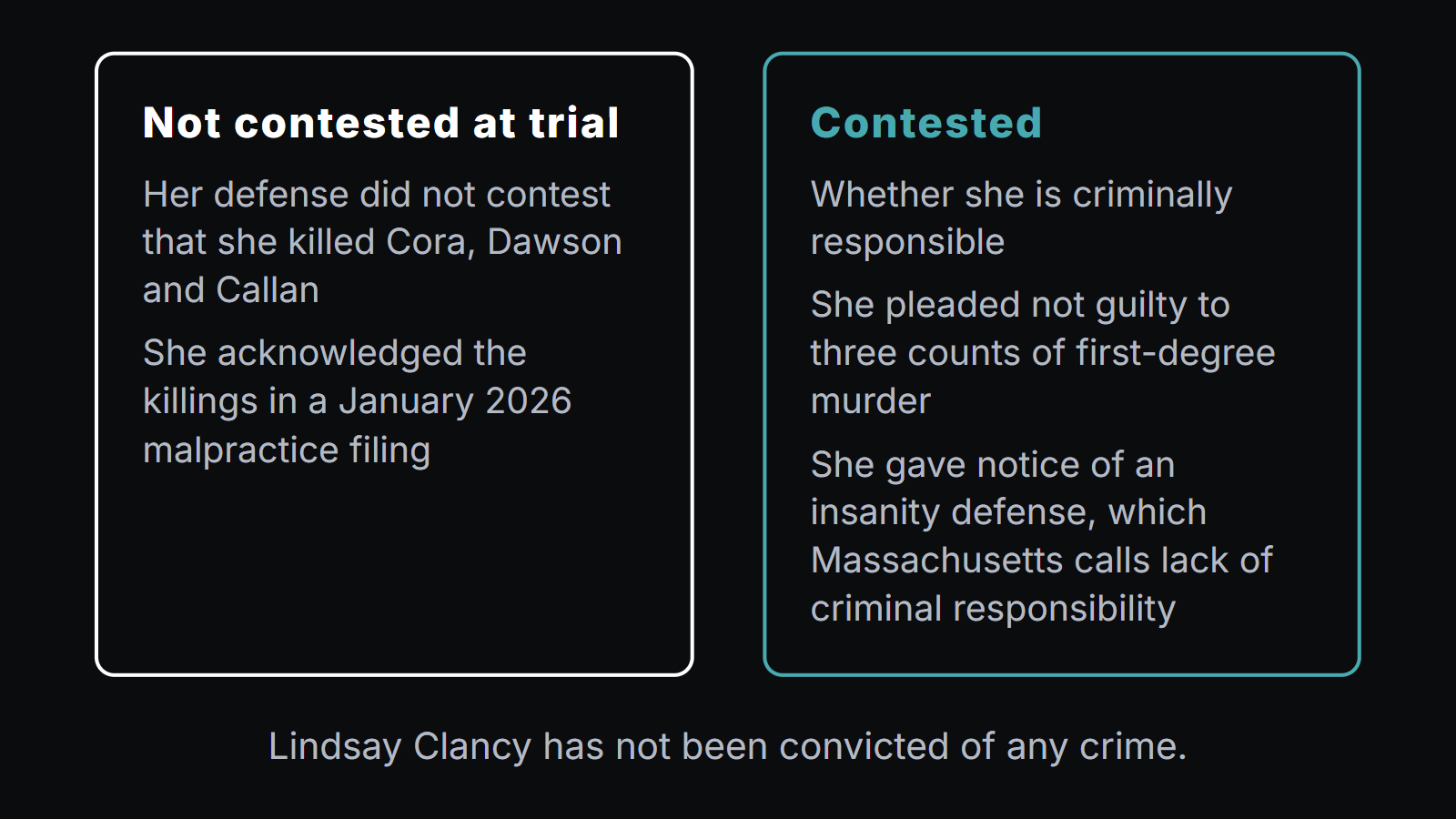
Yes, in effect. Her defense did not contest at trial that she killed Cora, Dawson and Callan, and she acknowledged the killings in a January 2026 medical malpractice filing. What she contests is responsibility. She pleaded not guilty to three counts of first-degree murder and gave notice of an insanity defense, which Massachusetts calls lack of criminal responsibility.
Her lawyer even offered prosecutors a written stipulation to her involvement in April 2026, hoping to keep the trial focused on her mental state. Prosecutors did not agree to it, and Judge William Sullivan rejected the request.
Some posts online claim Patrick was responsible instead. No evidence presented at trial supported that. Patrick testified as the prosecution’s first witness, and Reddington has said Clancy herself rejects those theories.
Postpartum Psychosis or a Plan? The Same Evening, Read Two Ways
The whole trial came down to one question: was Clancy so ill on January 24, 2023, that she could not appreciate that what she was doing was wrong? The defense said yes, pointing to postpartum psychosis and bipolar disorder. Prosecutors said no, describing a severely depressed woman who still understood her actions.
Forensic psychiatrist Dr. Phillip Resnick, who testified for the defense at Andrea Yates’s 2006 retrial, took the stand for Clancy too. He told jurors she was “clearly psychotic” at the time of the crime and had a command hallucination. Psychologist Paul Zeizel testified that she described a male voice ordering her to kill the children and then herself. For the prosecution, Dr. Avram Mack found a major depressive episode but no evidence of psychosis, and Dr. Gregory Saathoff said her ability to carry out each step without direction showed she “had control.”
Postpartum psychosis is rare. The most widely cited estimate puts it at about 1 to 2 cases per 1,000 births, a figure that traces to a 1987 Scottish study. Newer studies put first-time cases lower. That rarity is part of why the diagnosis carries so much weight, and draws so much doubt, in a courtroom.
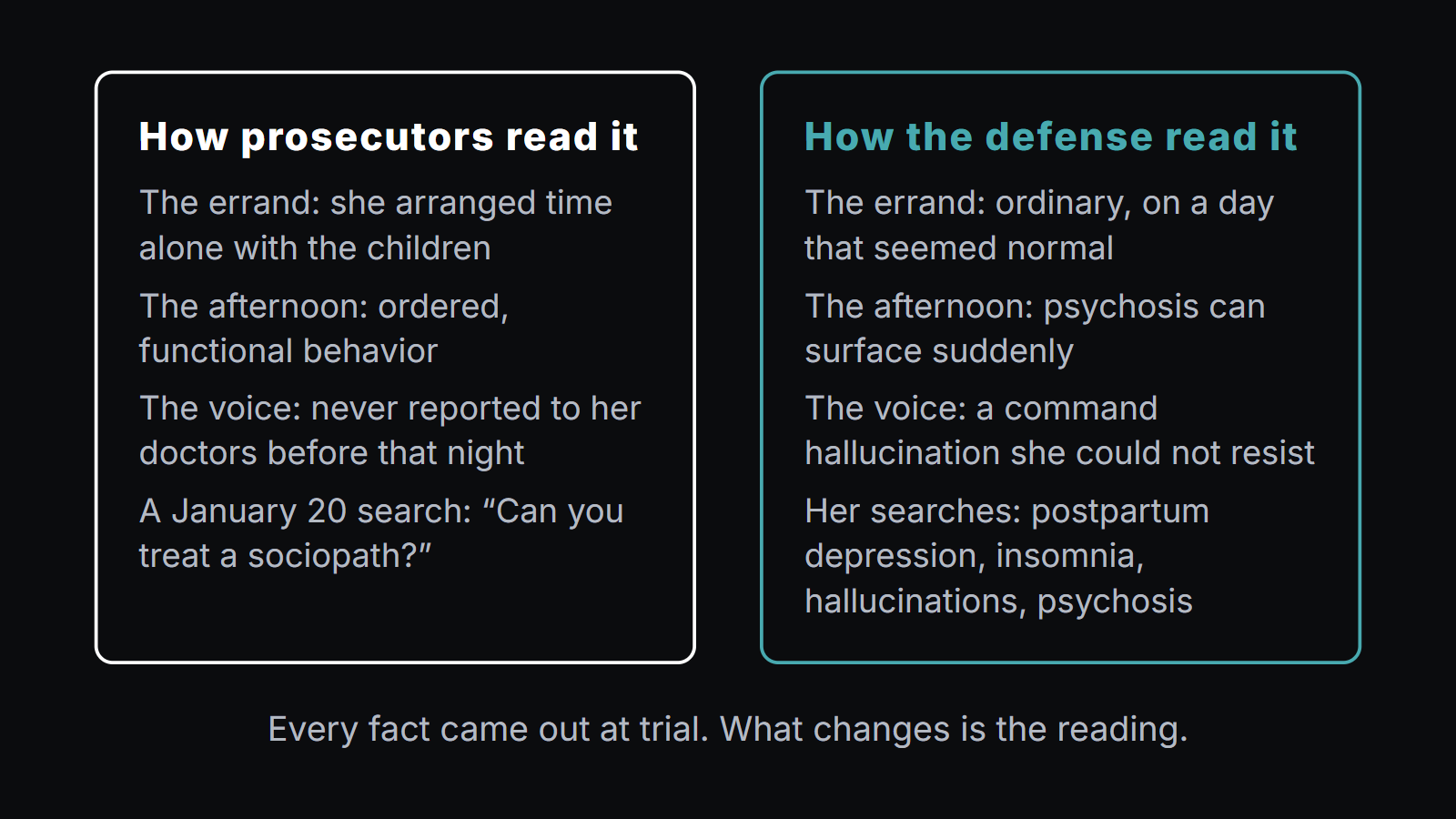
The most useful way to understand the mistrial is to see how both sides told the same evening. Every fact below came out at trial. What changes is the reading.
| What happened | How prosecutors read it | How the defense read it |
|---|---|---|
| She asked Patrick to go out for food and medicine | She arranged time alone with the children | An ordinary errand on a day that seemed normal |
| A calm afternoon with a snowman and photos | Ordered, functional behavior right up to the killings | Psychosis can surface suddenly in someone who looked fine hours earlier |
| Her online searches | A January 20 search, four days earlier, for “Can you treat a sociopath?” showed she understood | Searches about postpartum depression, insomnia, hallucinations and psychosis showed a woman trying to get help |
| The male voice | Never reported to her doctors before that night, it stopped once the act was done, and her timeline shifted between evaluators | A command hallucination she had no power to resist |
| The suicide attempt | At times called insincere, at other times sincere | A near-fatal attempt that left her paralyzed |
| Her medical care | She had “more access to treatment and care and support than a lot of people do” and was not taking her medication as prescribed | “The damn medicine and the lousy medical care that she got” |
Read across the rows and the pattern is clear: the two sides rarely disagree about a fact. They disagree about what was going on inside her when it happened, and that is a question only a jury can answer.
How Massachusetts Decides Whether She Is Criminally Responsible
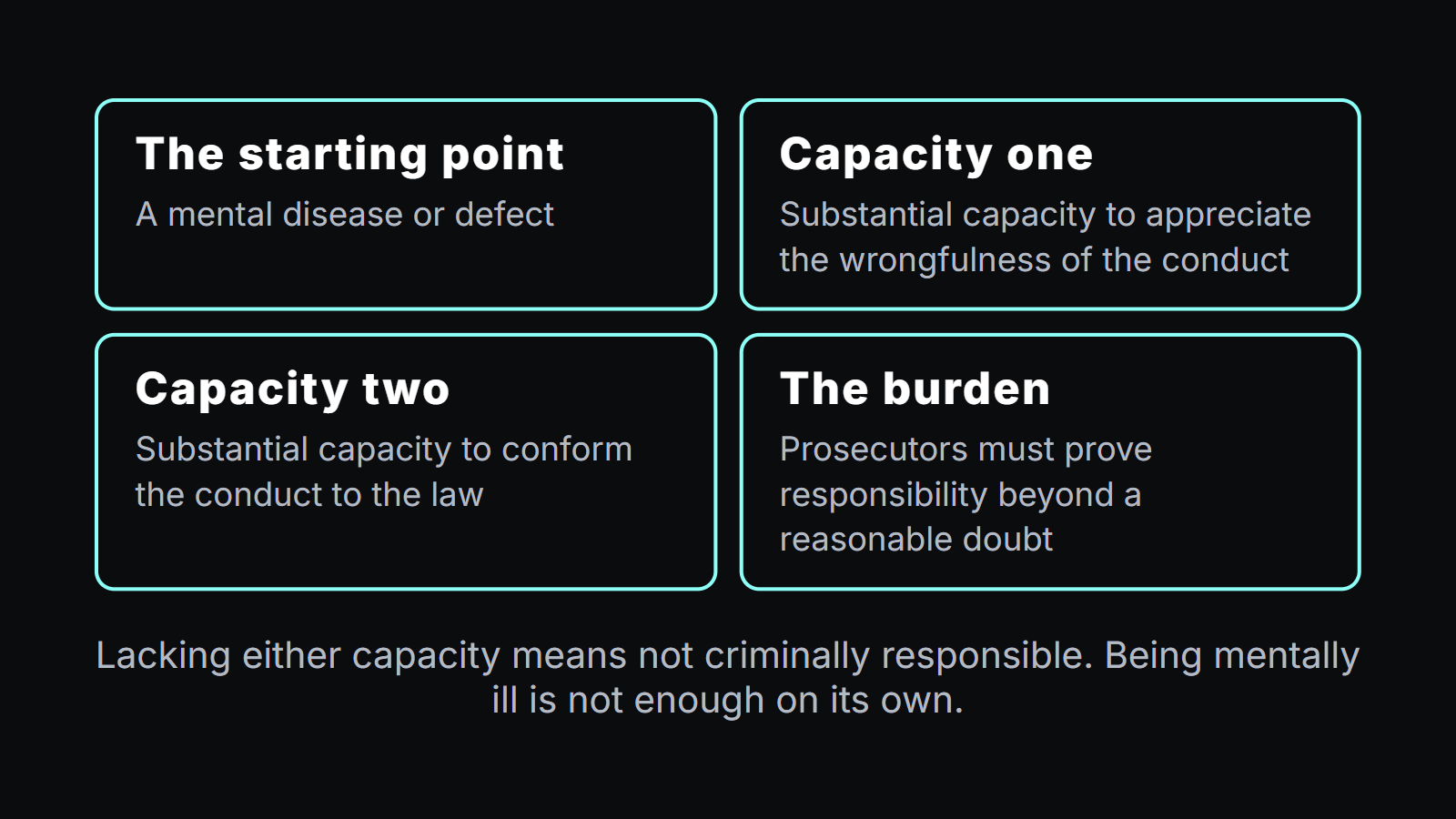
Under the Massachusetts model jury instructions on criminal responsibility, a person is not criminally responsible if a mental disease or defect leaves them without substantial capacity either to appreciate the wrongfulness of their conduct or to conform it to the law. Once the defense raises the issue, prosecutors must prove beyond a reasonable doubt that the defendant was criminally responsible.
Being mentally ill is not enough on its own. Picture a juror who fully accepts that Clancy was severely ill that winter. That juror still has to decide whether the illness took away her capacity to understand that killing her children was wrong. If prosecutors leave a reasonable doubt on that point, the law requires a verdict of not guilty by reason of lack of criminal responsibility.
Jurors had five options:
- Guilty of three counts of first-degree murder, which carries life in prison without parole in Massachusetts.
- Guilty of second-degree murder, which carries life with the possibility of parole.
- Guilty of manslaughter.
- Not guilty.
- Not guilty by reason of lack of criminal responsibility. Prosecutors could then ask a court to commit her to a state mental health facility, in orders that are reviewed and can be renewed indefinitely, potentially for life.
So can Lindsay Clancy be found not guilty? Yes, but the realistic not-guilty outcome is the insanity verdict, and that does not mean she goes home. District Attorney Timothy Cruz also has the authority to retry her on a lesser charge, such as second-degree murder or manslaughter. As of November 16, prosecutors had not formally said which charges they will retry, and the indictment still reads three counts of first-degree murder.
Walk the Jury’s Path
Answer each question the way a juror might, and see where the law sends the verdict.
For informational purposes only. This is a simplified walk-through of the verdict options described in court and in news coverage, not the actual jury instructions, and it does not predict any outcome. Lindsay Clancy has not been convicted of any crime. Not legal advice. Your answers stay in your browser; nothing is recorded or transmitted.
The Trial: Five Weeks, 85 Witnesses and One Holdout
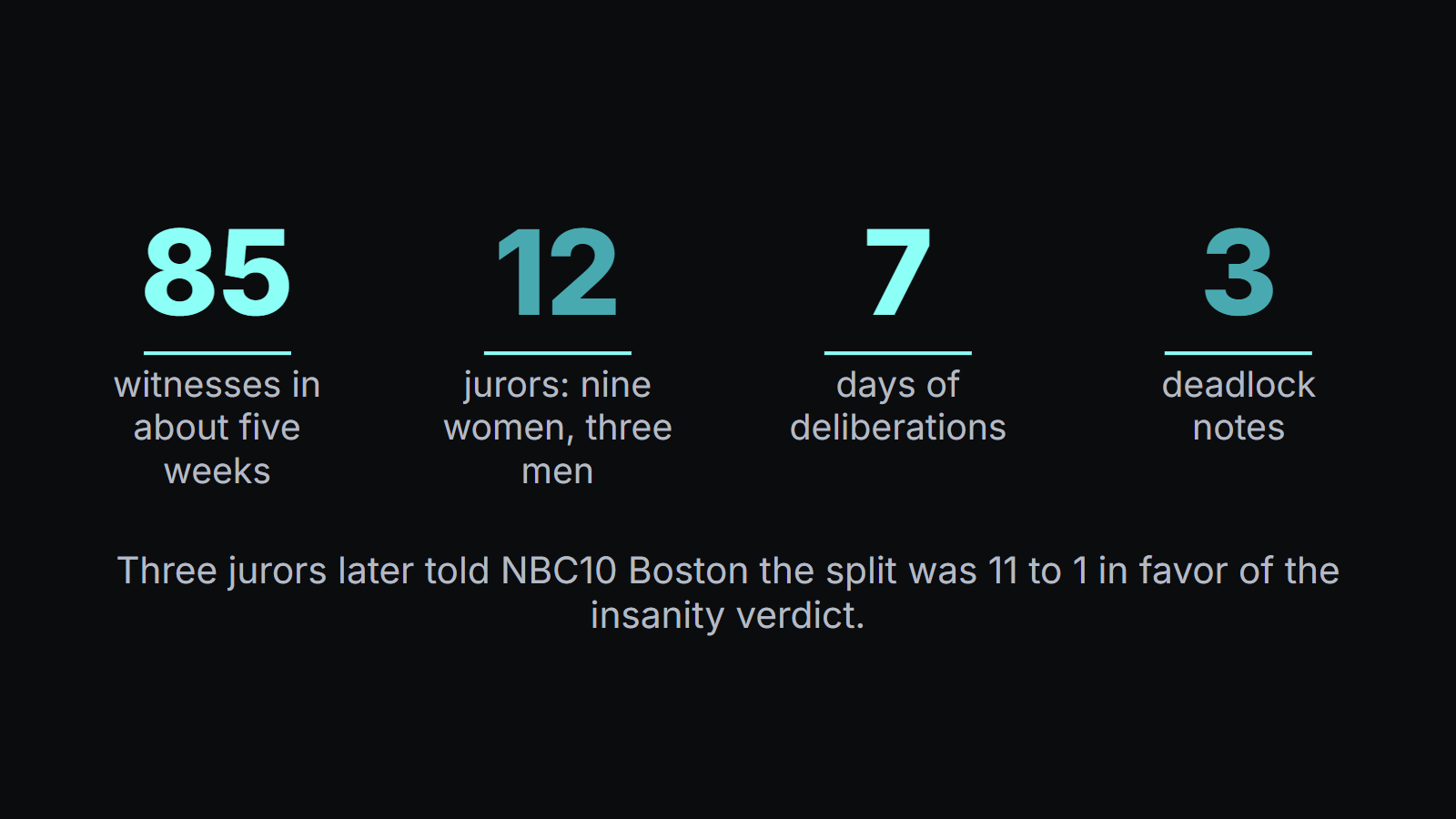
Commonwealth v. Lindsay Clancy opened in Plymouth Superior Court with jury selection on July 20, 2026, and opening statements on July 27. Assistant District Attorneys Jennifer Sprague and Shanan Buckingham prosecuted the case, and Kevin Reddington led the defense. Over about five weeks, jurors heard from 85 witnesses and saw hundreds of exhibits. Clancy did not testify.
Patrick was the first witness. Clancy sobbed in court as his 911 call played. Her mother testified that Clancy spoke of thoughts of harming the children and felt her medications were destroying her mind. Her sister described her suicidal thoughts, and her former mother-in-law read a text in which Clancy said she was terrified of taking her medication.
Closing arguments came on August 27. Jurors, nine women and three men, deliberated for seven days. They reported a deadlock twice, and the foreperson sent a separate note saying one juror acknowledged doubt but refused to apply it. After a third deadlock note, and after a single justice of the state’s highest court denied a defense emergency request, Sullivan declared a mistrial on September 4, 2026.
Three jurors later told NBC10 Boston that the split was 11 to 1 in favor of the insanity verdict. The foreperson said the lone holdout admitted he had reasonable doubt but still refused to vote not guilty by reason of insanity. The judge temporarily sealed the jurors’ names. During deliberations, a woman was arrested and charged with intimidating a juror after allegedly filming jurors; she pleaded not guilty.
Why Is There a Retrial, and When Is It?
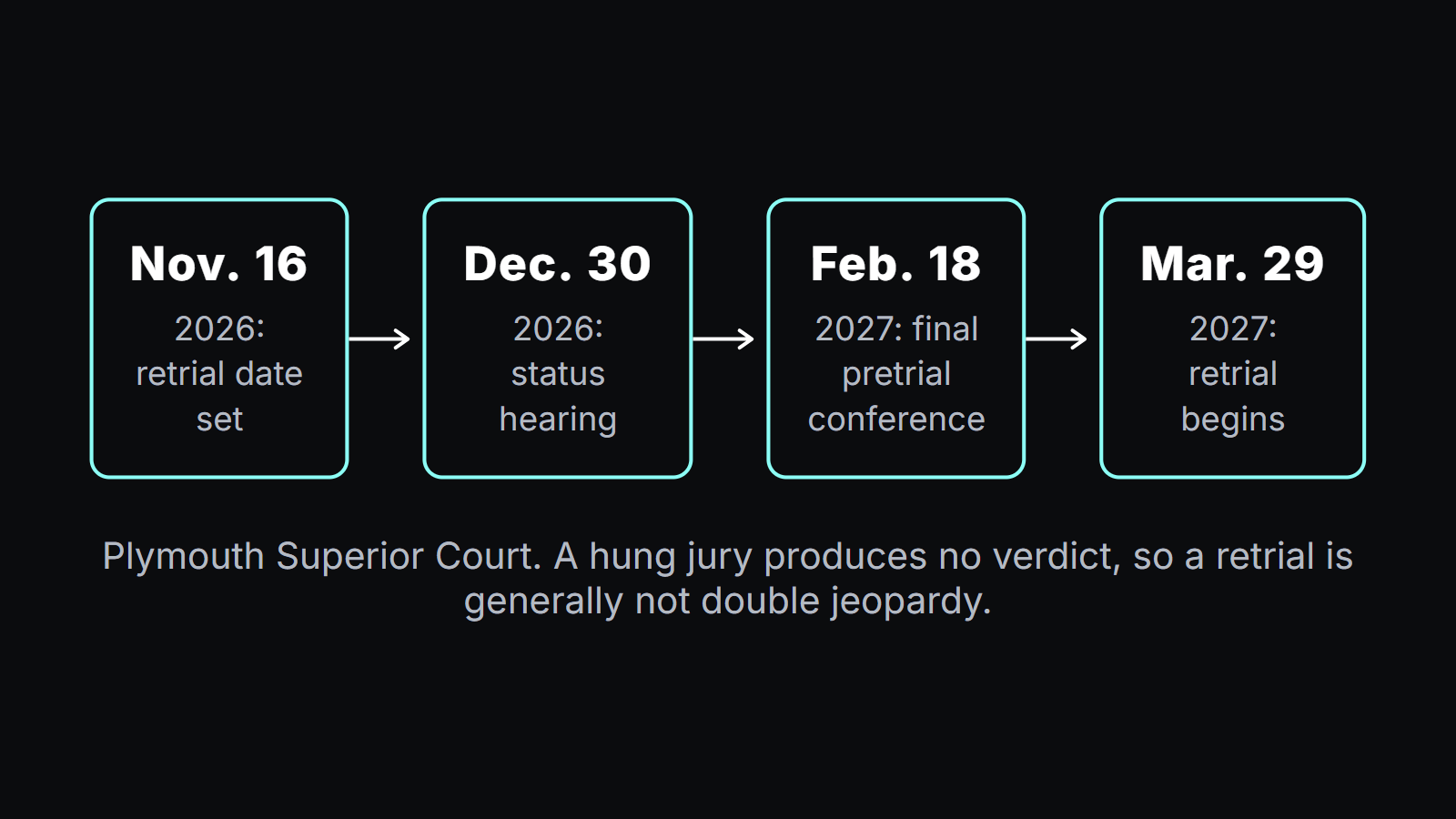
Lindsay Clancy’s retrial is set to begin on March 29, 2027, in Plymouth Superior Court. A status hearing follows on December 30, 2026, and a final pretrial conference on February 18, 2027. Judge Sullivan set the date on November 16, 2026, after prosecutors asked for a later spring date.
A hung jury produces no verdict, so a retrial is generally not double jeopardy. The defense argued otherwise, saying there was no “manifest necessity” for a mistrial because the court could have questioned or replaced the holdout juror. On November 9, Sullivan denied the motion to dismiss, finding the deadlock was a manifest necessity and that questioning the holdout would have been coercive.
Reddington has said he will again ask to split the trial into two phases: one on guilt, one on her mental state. Sullivan denied that request before the first trial. He has also said he would never accept a plea deal that puts Clancy behind bars.
Retrials in insanity cases can end differently. Andrea Yates drowned her five children in Texas in 2001 and was convicted at her first trial. That conviction was overturned in 2005, and a second jury found her not guilty by reason of insanity in July 2006.
Imagine being summoned for jury duty in Plymouth County next March. You will almost certainly have heard of this case, possibly seen clips of the first trial, and maybe read about the holdout. Jury selection will test whether 12 people can set all of that aside.
Public Perception and Media: Why This Case Split the Internet
Four days after the killings, Patrick posted a statement on a family GoFundMe asking the public to forgive Lindsay and saying he already had. The fundraiser passed $1 million within about 10 days, from more than 15,000 donations. He filed for divorce in February 2024.
The trial was livestreamed and became one of the most closely followed of 2026, dissected on TikTok, X and some of the biggest true crime podcasts. Arguments over whether to sympathize with her spilled into personal relationships. After the mistrial, the holdout juror faced a wave of public anger. Like the Delphi murders trial before it, the case showed how much of a modern trial now plays out online while jurors are still deciding.
Even national politics touched it. President Trump condemned the killings, and after the mistrial Reddington publicly asked him for a pardon, though a president has no power to pardon state crimes.
The Lawsuits and the Legacy of the Clancy Case
In January 2026, Lindsay and Patrick filed separate malpractice lawsuits in Norfolk Superior Court against the providers who treated her. Patrick’s wrongful death suit names Tufts, nurse practitioner Rebecca Jollotta, Aster Mental Health and South Shore Health System. Lindsay’s suit names 11 defendants, including Women and Infants Hospital and McLean Hospital. Those claims are allegations, and providers who testified said they adjusted her treatment based on how she responded.
In Duxbury, neighbors held vigils. On the first anniversary, the nonprofit With Love, From Duxbury organized a memorial service. Beyond the town, the case has pushed postpartum mental health into a public argument. People are debating missed diagnoses, frequent medication changes and how families can tell an emergency from a hard season.
What Is the Latest in the Lindsay Clancy Case in 2026?
As of November 16, 2026, Lindsay Clancy faces three counts of first-degree murder and a retrial scheduled for March 29, 2027. The next status hearing is December 30. She remains held at Tewksbury Hospital. After the November 16 hearing, Reddington told reporters he felt bad for her and for her family. We will update this page as the retrial approaches.
Frequently Asked Questions
Is the Lindsay Clancy trial over?
No. Her first trial ended in a mistrial on September 4, 2026, and a retrial is set to begin March 29, 2027.
Did Lindsay Clancy plead guilty or not guilty?
Not guilty. She pleaded not guilty to three counts of first-degree murder and argued she was not criminally responsible because of mental illness.
Was Lindsay Clancy diagnosed with postpartum psychosis?
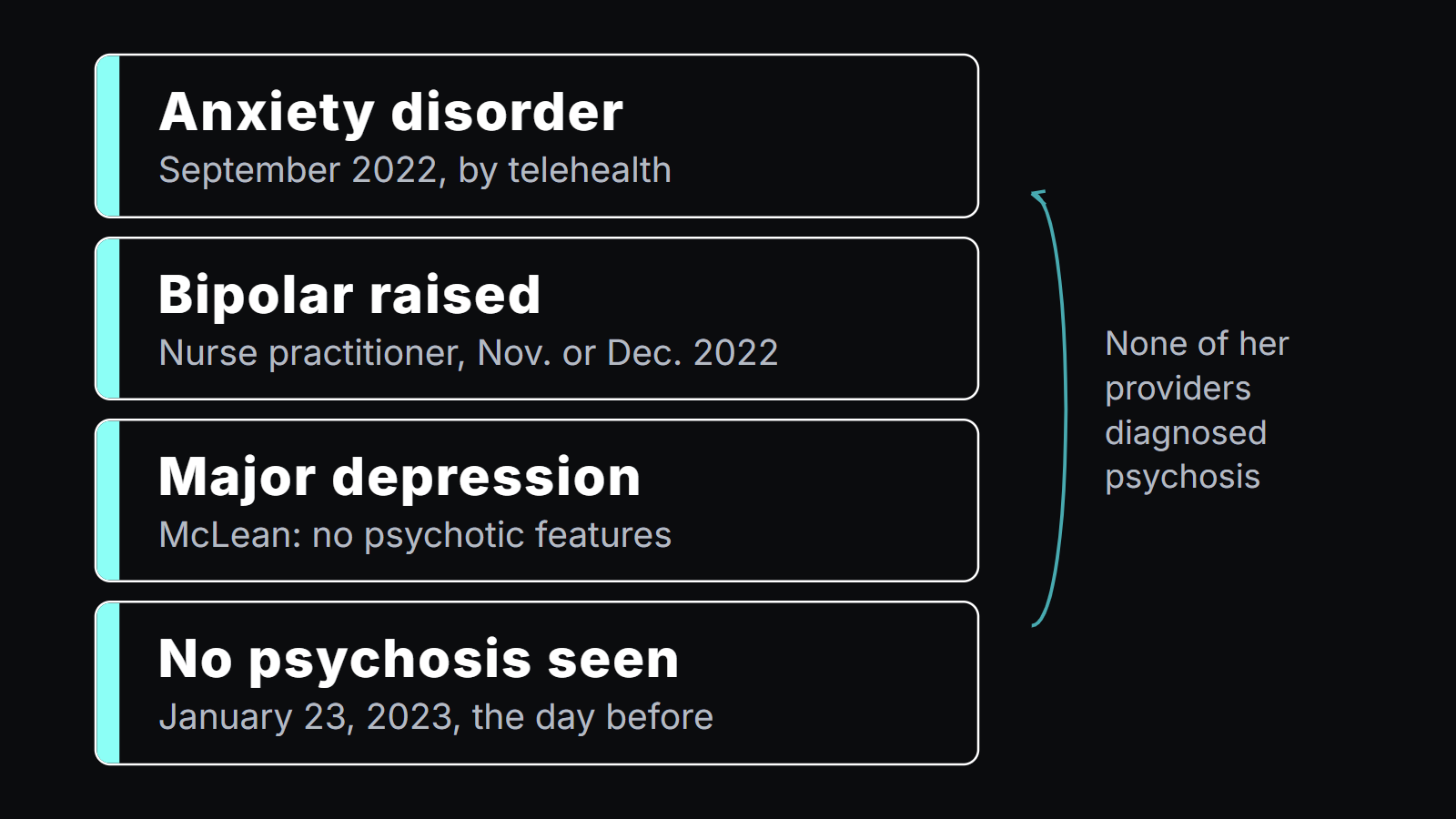
Not before the killings. Her providers diagnosed anxiety and later severe depression without psychotic features. Defense experts testified she was in postpartum psychosis at the time of the killings; prosecution experts found no psychosis.
Where is Lindsay Clancy now?
She is held without bail at Tewksbury Hospital, a Massachusetts state psychiatric hospital, while she awaits retrial.
What sentence could Lindsay Clancy face?
A first-degree murder conviction carries life without parole in Massachusetts. A verdict of not guilty by reason of lack of criminal responsibility would let prosecutors seek her commitment to a state mental health facility, renewable indefinitely.
More True Crime From Slaycation
Slaycation usually follows the trips that go wrong, but some of the hardest cases never leave home. We will keep this one current through the March retrial. For the travel cases that started the show, browse the latest Slaycation episodes.
References
- NBC News, “Lindsay Clancy retrial scheduled for March over the strangulation deaths of her three children,” November 16, 2026; CBS Boston, November 16, 2026 (retrial date, pretrial and status hearings, plea and bifurcation statements).
- PBS NewsHour / Associated Press, “Jurors speak out about Lindsay Clancy mistrial and the lone holdout,” September 9, 2026; NPR, September 4, 2026 (mistrial).
- CNN via ABC17, “A dedicated mother and her downward spiral: the testimony of Lindsay Clancy’s ex-husband,” August 2026 (Patrick Clancy’s testimony).
- GBH News / Associated Press, closing arguments, August 27, 2026; Associated Press coverage of Dr. Phillip Resnick’s and Dr. Avram Mack’s testimony, August 21 to 25, 2026; Newsweek on Dr. Gregory Saathoff’s testimony, August 2026.
- Boston Globe, trial coverage, August 4, 2026 (surgeon testimony; Tewksbury Hospital); NBC10 Boston and WCVB (Tewksbury transfer).
- Massachusetts Supreme Judicial Court, Model Jury Instructions on Homicide, criminal responsibility.
- Wikipedia, “Killing of the Clancy children” (case chronology, civil suits), cross-checked against the outlets above.
- Health Resources and Services Administration, National Maternal Mental Health Hotline.